
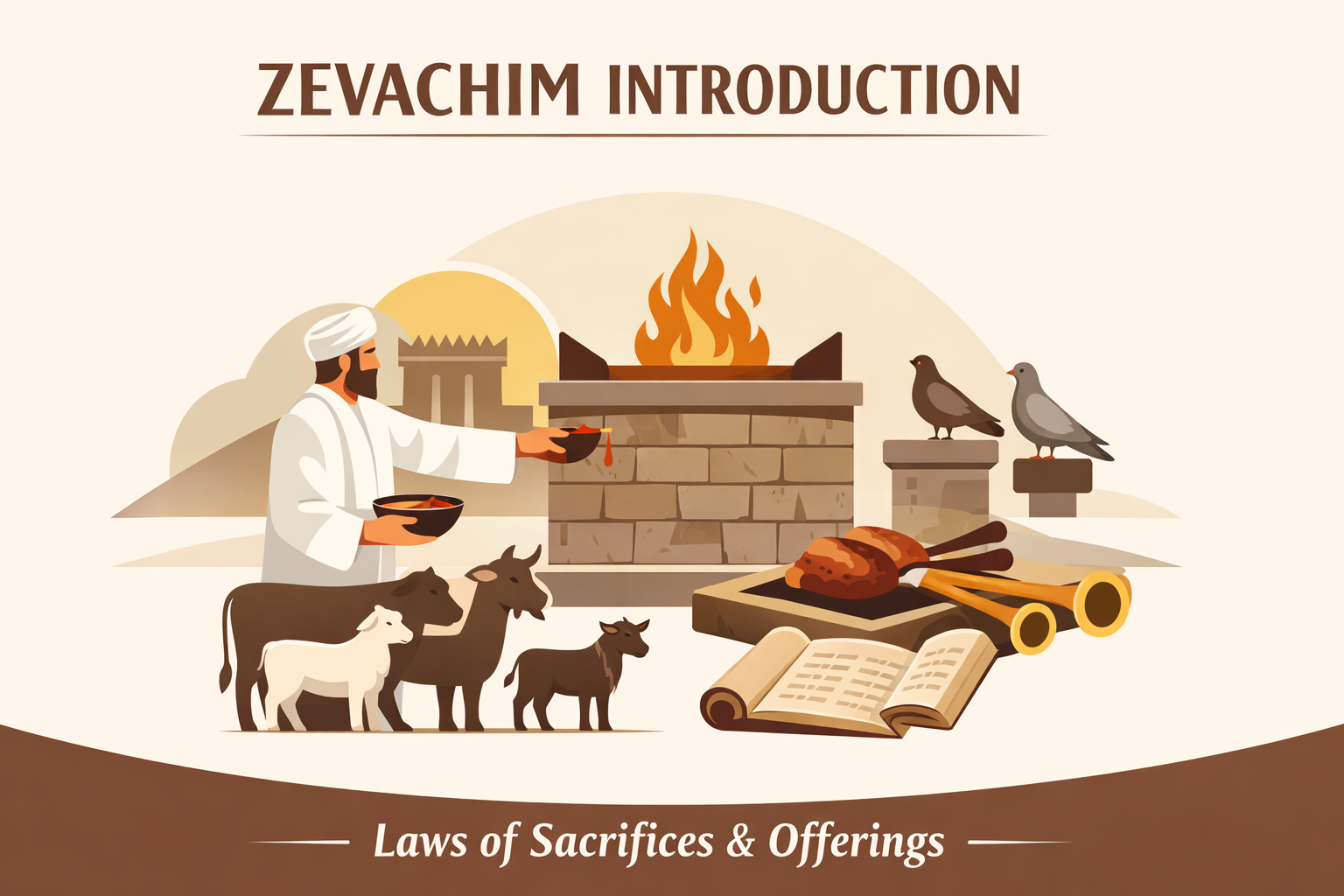
This tractate deals with the laws of animal and bird sacrifices. It is the first volume of Seder Kodashim. The essential part of an offering of this type is the application of its blood on the mizbeiach. That service is what renders the offering valid. A valid korban means that now it has the power to atone. Parts of the animal called emurim are placed on the alter to be burned, and the rest is eaten by the kohanim or by the owner of the sacrifices and his/her guests. The species of animals that can be brought as a korban are oxen, sheep, and goats. There are eight categories of korbonos brought: Chatas, Oleh, Asham, Shlomim, Todah, Bechor, Maaser, and Pesach. The bird offering is either the chatas haoif or the olas haoif. For all these korbonos the owner is the one who consecrated the animal to be an offering or the person for whose benefit an offering has been consecrated by someone else. The owner must do semichah (lean on the animal) and see to it that the meat of the kodashim kalim is eaten within the necessary time. He may share the meat with whomever he wishes. The avoda must be done by a qualified Kohen who has no mum.
What invalidates a korbon?
- Kohen was tomei
- Kohen was an onein
- Kohen didn’t wash his hands and feet
- Kohen didn’t wear special clothing (bigdei kohuna)
- Kohen did the avodah sitting
- Kohen didn’t have bare feet to temple floor
- Kohen didn’t use right hand
- Kohen drank wine before avoda
- Kohen has long hair
- Animal had mum
- Animal killed someone
- Animal was used in a perverse act
- Animal was used as a payment for a zonah
- Animal was exchanged for a dog
- Improper intent: (1) wrong korbon, (2) wrong host, (3) pigul, (4) wrong place
Mesechta Zevachim (120A)
The Gemara at the end of the mesechta on 120A is speaking about a bamah, which is an alter – a mizbeiach – and the Gemara wants to know if the din is the same for a private alter and a (major) communal alter. This was at a time when the Beis Hamikdosh was not standing. Because if it was, then a bamah would not be permitted to be used to bring a korban. The Gemara begins to prove this by first showing that just as the din of taking a korban outside Yerushalayim disqualifies it, but yet on a bamah it would not because a bamah has no set perimeters, so too leftover (nosor) which must be burned would not be applicable for a bamah. Also, therefore nosor would not invalidate a korban on a bamah if it was not burned and kept overnight. Asks the Gemara [start reading from here the words v’lav kal v’chomer meiofos…] Using a kal v’chomer, we could knock off this proof by showing that birds that are brought as a korban are not disqualified due to a blemish, yet if it is kept beyond its time and not burned, it is invalid. So certainly, sacrifices brought on a bamah which is disqualified due to a blemish will be invalidated on account of time if it’s not burned at the right time. The Gemara disproves this kal v’chomer because it is necessary for a Kohen to sacrifice a bird, whereas a korban brought on bamah does not need a Kohen to sacrifice it. So let time not invalidate a private bamah. Therefore, comes the Posek “v’zos toras zevneh hashlamim”, meaning all shlamim have the same din, and just as time invalidates a major bamah so too it invalidates a minor bamah and so too nosor – leftover unburnt.