
Introduction
Mesechta Megilla is part of Sefer Moed. It is the 10th tractate. According to the Rambam, the tractate of Megillah follows the tractate of Taanis because the laws related to Purim were established by the prophets who lived after those who established the fast days. These rabbis were probably the Anshei keneses hagedolah. I don’t know why the Rambam refers to them as prophets. They certainly had ruach hakodesh but not nevuah.
The Four Purim Mitzvos Explained in Mesechta Megilla
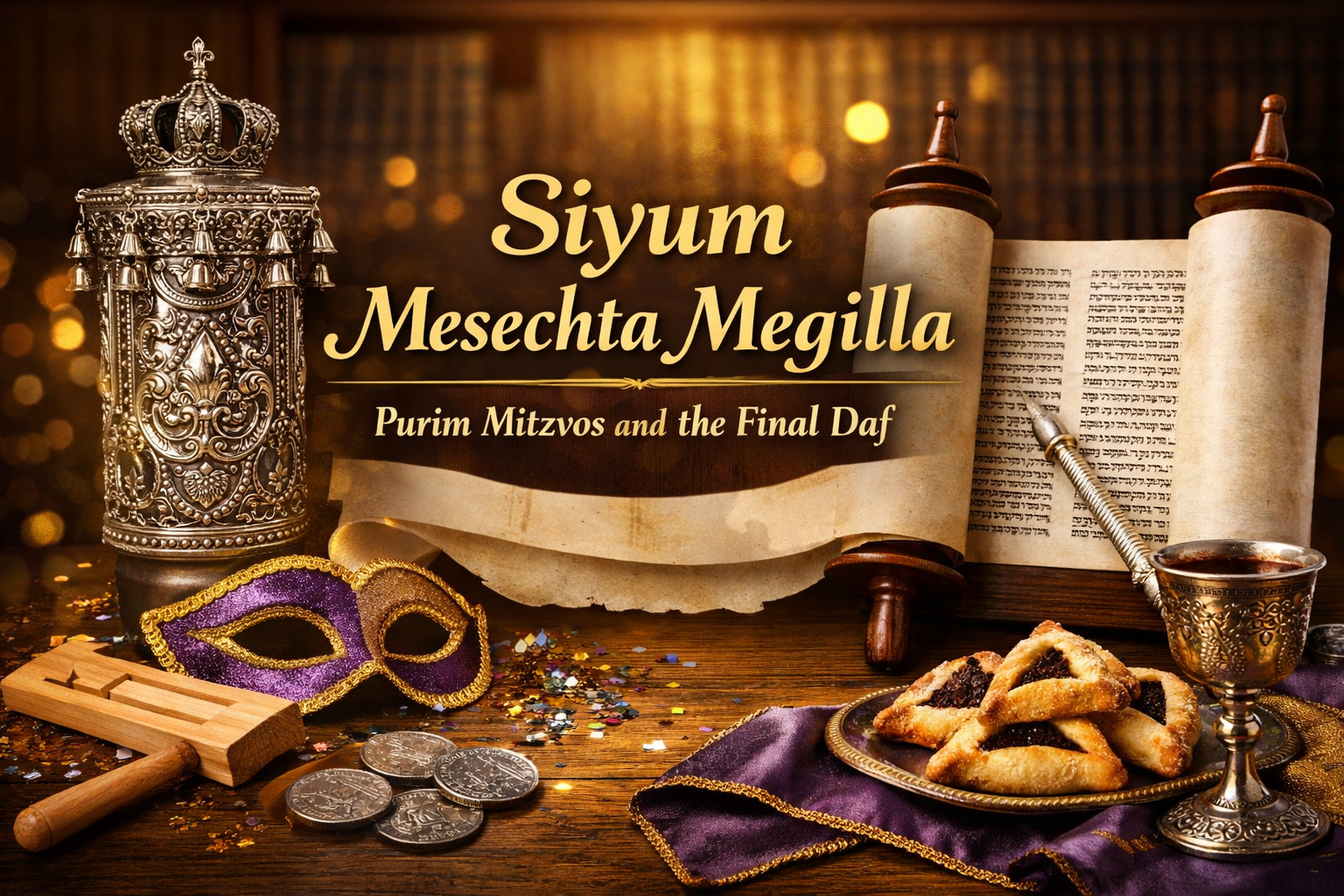
This mesechta deals with the four mitzvos that we are obligated to fulfill on Purim: (A) mikreh megilla (B) the seuda (C) matanos l’evyonim (D) mishloach manos. Two other mitzvos discussed in this gemara are the Fast of Esther and the custom to give a half a shekel (usually 3 half dollar coins wrapped together). Other halachos in this tractate include which locations may read the megilla on which days, also laws about reading the megilla out of sequence, who is permitted to read it for others, and the time of day and night other mitzvos may be performed. Torah reading laws are here too, as well as the level of holiness each holy item has concerning the level of honor due them. The custom to spin the gragger, eat hamantosh, and wear costumes are not in this gemara, but their customs are understood in how they connect with Purim. Parshas Zochor is read on the Shabbos before Purim, which commands us to erase the name of Amalek. There is a widely known custom to get drunk on Purim. One explanation may be to reach a state of mind where you can’t make any calculations, which is what got the Jews in trouble in the first place. They agreed to go to the party given by the king because otherwise, the king will resent it. That was a mistake.
Megilla Daf 32 – Summary and Key Halachos
Megilla Daf 32
The Last Daf of Mesechta Megila teaches us a few halachos concerning the Sefer Torah and other interesting things. Among these halachos are the following:
Halachos of Torah Blessings, Hagba, and Torah Handling
- There is a dispute between Rabbi Meir and Rabbi Yehuda about the procedure in saying the Bracha on the Torah. According to Rebbi Meir, one who is called to the Torah is shown a place by the Baal Koreh. He then closes the Torah, makes the Bracha, and reopens it so that the Baal Koreh can begin reading. According to Rabbi Yehuda, the one who called up for the Aliya sees the place but does not reclose the Sefer Torah. We pasken like Rebbi Yehuda and in addition the Halacha states that the Oleh LeTorah should close his eyes or look to the side while reciting the Bracha so that it does not look like the Brachos are written in the Torah. An advantage of keeping the Torah open is that the Baal Koreh can find his place when he restarts reading. We also witness this happening that the Baal Koreh cannot find the place again after the Bracha is said because the Torah was closed so his eyes left the proper place to start.
- Rav Shaftiah said in the name of Rav Yochanan that when one is ready to do Hagba (lifting the Torah) he should position the scroll on the seam so that if it tears it will do so on the seam where it can be resewn. Unlike it tearing off the seam, the whole column would need to be rewritten and sometimes a few columns.
- When handling the Sefer Torah, Rav Parnach said in the name of Rav Yochanan, that he may not touch the Klaf (parchment) with his bare hands, instead use a piece of material to grasp it. If he does not do it this way, then he loses the Mitzva that he just performed, be it reading from the Torah, or doing Gelilah (the process of rolling it closed), etc.
Torah Reading on Yom Tov – Biblical Source and Explanation
- How do we know that when a Yom Tov comes we must read from the Torah about that Yom Tov? Because it says in Vayikra 23:44, “Vayedaber Moshe Es Moadei Hashem El Benei Yisrael” “And Moshe declares the festivals of Hashem to the Benei Yisrael.” In addition the Pasuk teaches us that when the Yom Tov comes, Moshe would gather the Jews and discuss with them the laws of Yom Tov (Rashi).
Learn More About Other Mesechtas
For more info on other mesechtas, call (347) 962-1509