
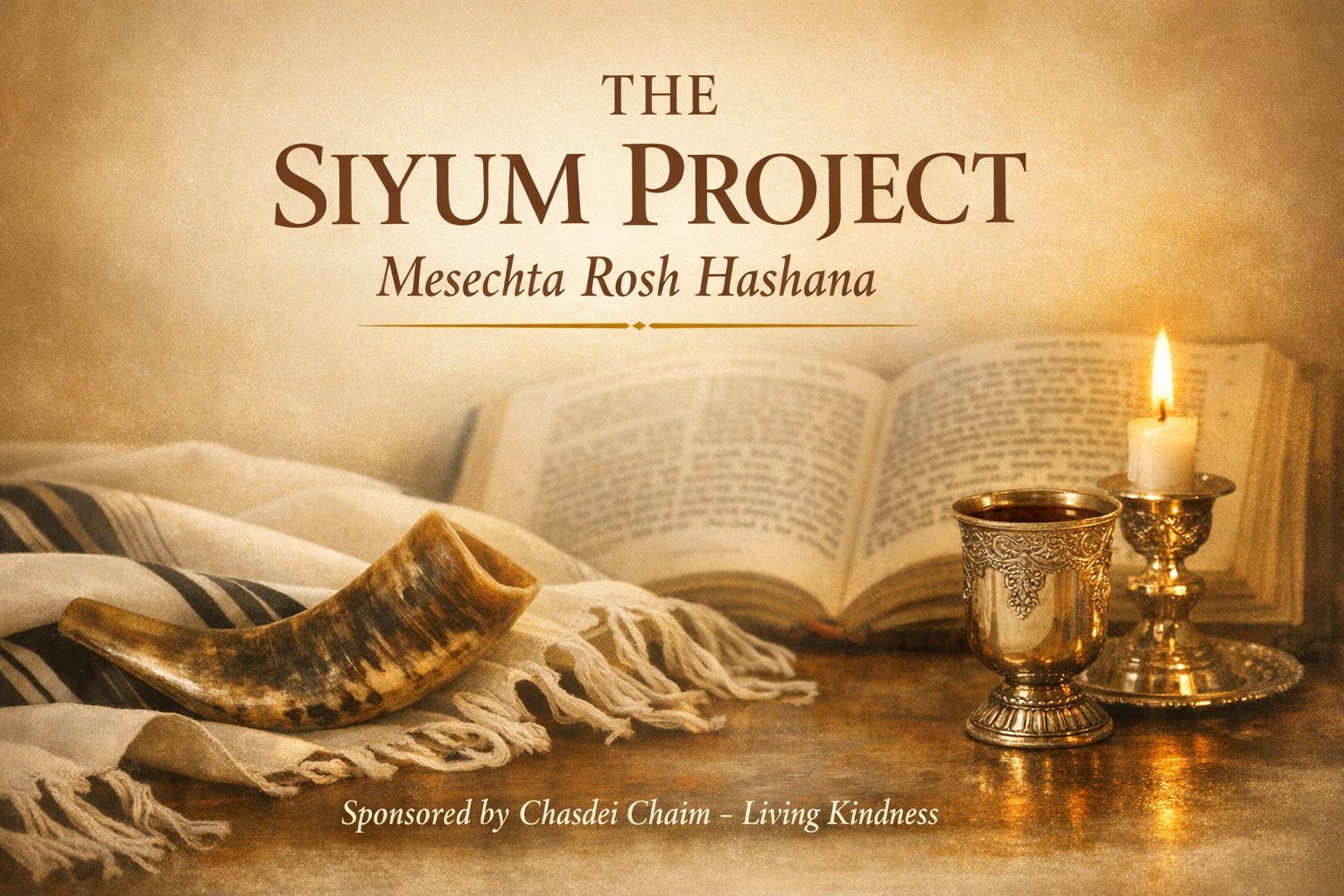
Introduction
(with help from Artscroll)
The first day of the month of Tishrei marks the New Year. We celebrate Rosh Hashana — the first two days — when Hashem sits in judgment over all mankind.
We blow the shofar (Vayikra 23:24; Bamidbar 29:1) so that we may be remembered before Him.
According to Rebbe Eliezer, this day marks the creation of the world and mankind (though creation itself began on the 25th of Elul).
The phrase Rosh Hashana is also used to refer to other significant beginnings. The first Mishna lists them as follows:
- 1st of Nissan – Rosh Hashana for kings (to indicate when a king’s reign began)
- 1st of Elul – Rosh Hashana for tithing animals
- 1st of Tishrei – Rosh Hashana for Shemita and Yovel
- 15th of Shvat – Rosh Hashana for trees (Tu B’Shvat)
These are among those listed in the Mishnah.
The Jewish Calendar & Kiddush HaChodesh
A significant portion of this mesechta discusses the Jewish calendar and how Rosh Chodesh was established each month.
Rosh Chodesh was determined based on the cycles of the moon, tying the festivals to specific dates depending on when the new month was sanctified.
The Beis Din was tasked with sanctifying the renewal of the month (Kiddush HaChodesh), based on the pasuk in Shemos 12:2:
“Hachodesh hazeh lachem rosh chodoshim.”
They relied on the testimony of two witnesses who saw the first visible phase of the moon after the molad. These witnesses were carefully screened and interrogated to determine the reliability of their testimony. Upon confirmation, the Beis Din would declare Rosh Chodesh.
Why We Observe Two Days of Yom Tov in the Diaspora
The observance of two-day Yom Tov in the Diaspora originated because messengers sent by the Beis Din could not always reach distant communities in time to inform them when Rosh Chodesh had been declared.
As a result, communities observed two days out of doubt — in case Rosh Chodesh had been declared a day later.
Even after the calendar was fixed, this custom remained.
Mesechta Rosh Hashana
The Final Piece – Daf 38a
(Starting five lines from the end)
Rebbe Acha, the son of Avira, said in the name of Rebbe Shimon Chasida that Rabban Gamliel did not require even those working in the fields to come to shul. Instead, the minyan in shul would be motzei them.
Each community was obligated to send a minyan to shul so that a shliach tzibur could daven on behalf of those who could not attend.
However, Rabban Gamliel’s language seems to imply that even those who do come to shul need not pray individually because the shliach tzibur will be motzei them.
Can this be true?
The workers in the field are forced to miss tefillah. But those who come to shul are not forced. Shouldn’t only those in the field be permitted to fulfill their obligation through the shliach tzibur?
The Gemara brings a proof from a similar case:
Abba, the son of Rav Binyamin Bar Chiya, stated that those who stand behind the kohanim during duchaning are not included in the blessing — since they could have positioned themselves properly but chose not to.
However, those in the fields who cannot come before the kohanim are included in the blessing.
The same principle should seemingly apply here.
Therefore, the Gemara revises the earlier statement. When Ravin came to Bavel, he said in the name of Rebbi Yaakov Bar Idi, who said in the name of Rebbi Shimon Chasida, that Rabban Gamliel only exempted the people in the fields.
Their obligation was fulfilled through the shliach tzibur because they were compelled by their occupation to be absent.
Those in town, however, were not exempt.
Sponsored by Chasdei Chaim – Living Kindness
Are you making a Siyum on Mesechta Rosh Hashana — or know someone who is?
We invite you to use our beautifully prepared Siyum presentation.
Other mesechtas are available as well.
📞 Call: (347) 962-1509
📧 Email: yachnesy@gmail.com
🌐 Website: living-kindness.org